A rental agreement is worth nothing while things go well. It earns its keep the day a car comes back with a dented wing and the customer says it was already like that.
Here is what it needs to hold up on that day.
What has to be in it
None of this is optional, and every missing line is an argument handed to the other side.
The parties, with the driver's licence number and its expiry. The vehicle, with plate, model and mileage at departure. The dates and times out and back, to the hour rather than the day. The price, itemised. The deposit, its amount and the conditions for returning it. Fuel at departure and the level expected on return. The authorised drivers, by name.
And the insurance cover, with the excess written as a figure. Most damage disputes come from a customer who believed they were fully covered.
The five most common omissions
Charges that arrive later. Tolls, fines, parking. Without a clause saying they are re-billed and at what administration fee, you end up claiming a sum the customer never agreed to. It is the most expensive omission on this list.
The permitted territory. Many agreements say nothing about borders. If your insurance does not cover a neighbouring country, the agreement has to say so.
Late returns. At what point does an hour late become a billed day? Write the threshold down, or it will be negotiated at the counter.
Mileage. Unlimited, or included with a price per kilometre beyond. In the second case the starting figure belongs in the signed agreement, not in a notebook.
Breakdown and downtime. Who pays for recovery, within what time you replace the vehicle, and what happens to the price if the customer spends three days without a car.
The condition report is worth more than the agreement
A perfect agreement does not prove the state of the vehicle at departure. Only photographs do.
Take them at departure and on return, every side, dated, with the odometer readable. Have the customer sign them on the spot, not the next day. In a dispute, a timestamped and countersigned set of photographs ends the conversation in thirty seconds, where a tick on a body diagram proves nothing.
That is why the condition report and the agreement belong in the same place. Kept apart, the photographs end up on a phone and the agreement in a folder, and on the day of the dispute nobody can find both.
Signing
A handwritten signature on paper is still valid, but it assumes you can find the paper. An electronic signature carries the same legal weight across the European Union as long as you can show who signed, when, and that the document has not changed since.
The practical advantage settles the argument anyway: an agreement signed on a screen reaches the customer by email within the second, and you keep a copy nobody can mislay.
One template per kind of rental
A three-day rental to a tourist and a six-month arrangement with a company do not need the same clauses. Short term, long term, corporate, chauffeur driven: keep a template for each rather than one agreement edited by hand, because an agreement edited by hand ends up carrying a clause from last year.
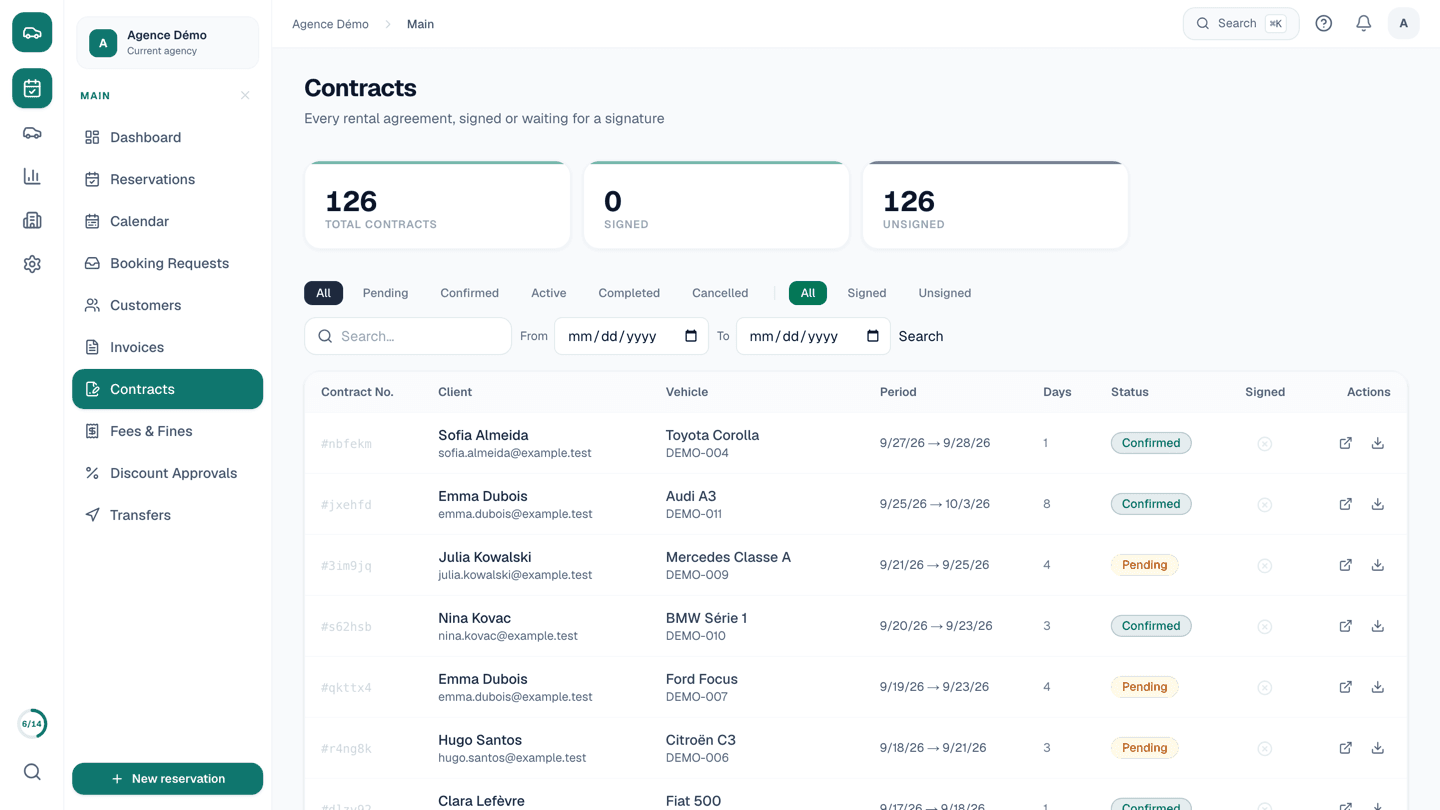
In Rentclic the templates are set up once, the right one is selected automatically from the duration and the type of customer, and the document goes out signed with the condition photographs attached to the same booking.
The clauses that fail when they are tested
A clause that exists is not the same as a clause that works. Four ways a well-meaning agreement falls over.
It was never shown before the signature. Terms on the back of a page the customer did not read, or an annex referred to but not handed over, are the first thing an adjudicator removes. If a condition matters, it belongs on the page the customer signs, not behind a link.
It is disproportionate. A penalty that bears no relation to the harm tends to be reduced to nothing rather than to something reasonable. Charging a hundred and fifty for a lost key is recovering a cost. Charging five hundred is inviting somebody to argue, and they will win.
It contradicts itself. The fuel policy in the terms says full-to-full, the counter takes a deposit for a full tank, and the invoice charges a service fee nobody mentioned. Three documents, three answers, no agreement.
Nobody can produce it. The signed version has to be retrievable eighteen months later, in the form it was signed. A contract you can still edit afterwards is a contract whose signature proves very little.
Second drivers, territory, and going abroad
Three clauses that seem minor until the day they are not.
The additional driver. Anyone who will drive must be named and their licence recorded before they do. An unnamed driver at the wheel is usually outside your insurance, which means a claim you thought was covered is yours. It is a two-minute step at the counter and it is the one most often skipped.
Where the vehicle may go. Say plainly which countries are allowed, and which are not. Ferries, unpaved roads and border crossings all appear in insurance conditions, and a customer who does not know that will discover it at the worst moment.
The long rental. Past a month, the wear assumptions in a daily agreement stop holding. Set a mileage allowance and a rate beyond it, agree who services the car and when, and say what happens if it needs to come back early. A three-month rental written on a three-day contract is a dispute waiting for a date.
The deposit deserves its own treatment: how much, when it comes back, and what you may keep is where most disputes actually start.
Read next
The named figures, vendor by vendor, are in six platforms and what they actually charge.
Questions people ask
What must a vehicle rental agreement contain?
The parties and the driver's licence details, the vehicle and its condition at handover, the dates and places of pickup and return, the price and what it includes, the deposit and when it comes back, the insurance and its excess, and what you may charge after the return. Anything you intend to bill later has to be named before the signature.
Is a photographed condition report legally useful?
It is the single most useful document you hold in a damage dispute, provided it is timestamped, shows the whole vehicle rather than the damage you already knew about, and the customer acknowledged it. A condition report the customer never saw proves that you took photographs, not that they agreed.
Can I keep the deposit for damage found after the return?
Only for damage you can show was not there at handover, which is what the condition report is for. Tell the customer what you are keeping and why, with the evidence, rather than letting the deposit quietly fail to return. Most disputes are about the silence, not the amount.
Does an electronic signature hold up on a rental agreement?
In most jurisdictions yes, if you can show who signed, when, and what exact document they were shown. Keep the signed version as it stood at that moment. A contract you can still edit afterwards is a contract whose signature proves very little.