One of your cars goes through a toll gantry. Six weeks later the operator sends you a single statement for the whole fleet: a plate, a timestamp, an amount, and a few hundred lines. The bill is yours. The driver was somebody else.
Most agencies deal with this by hand. Open the statement, find the plate, work out who had that car that day, add the line to an invoice. With twenty vehicles that is an afternoon a month. With fifty it stops happening, and the money is gone.
The work is repetitive, so it can be automated. As long as four things are right.
The four mistakes that bill the wrong person
| What goes wrong | What it looks like | What it costs |
|---|---|---|
| Time zone | The statement is in the operator's local time, your bookings are stored in UTC | Anything near a change of renter slides onto the previous rental, with nothing to flag it |
| Boundaries | A toll five minutes after the car came back | Either you pay for the drive to the depot, or you bill a customer for a passage that was not theirs |
| Plate formats | ABC-1234 in the statement, ABC1234 in your records | Nothing matches, and you conclude the feature does not work |
| Overlapping statements | The same passage appears in two consecutive files | The renter is billed twice for one gantry, and disputes it |
The time zone is worth a pause. Half past two in the afternoon in Florida is half past six UTC in July and half past seven in January, because the offset moves with daylight saving. Read the file as if it were UTC and every line shifts by four or five hours. That is exactly enough to move it from one renter to the one before.
The rule that decides who pays
From a plate and a moment, you look for the rental that was running. Three cases, and they are not equal.
The passage falls inside a rental. Nobody else could have been driving. Re-bill it.
The passage falls just outside one. A toll at 09:05 on a car returned at 09:00 is the renter driving to the depot. Do not decide for them: flag the gap and let a person judge.
No rental matches. The vehicle was with you, in transfer or in the workshop. That one is yours.
One case must never be guessed: two rentals claiming the same instant. That is a fault in your own records, and picking one of them means billing a stranger.
Say what your admin fee is
Every large rental company adds an administration fee per item, and every American rental agreement mentions it. Yours should too. One clause is enough: tolls, fines and parking incurred during the rental are re-billed, with a stated fee. Without that clause the line is a surprise, and a surprise on an invoice ends as a chargeback.
Never post it automatically
The strongest argument for reviewing each batch is not caution, it is arithmetic. A hundred lines matched in one click is a hundred customers billed in one click. If ten of them are wrong, you will find out through the first complaint. Match automatically, approve by hand, at least until the matching has proved itself over a few months.
How it works in Rentclic
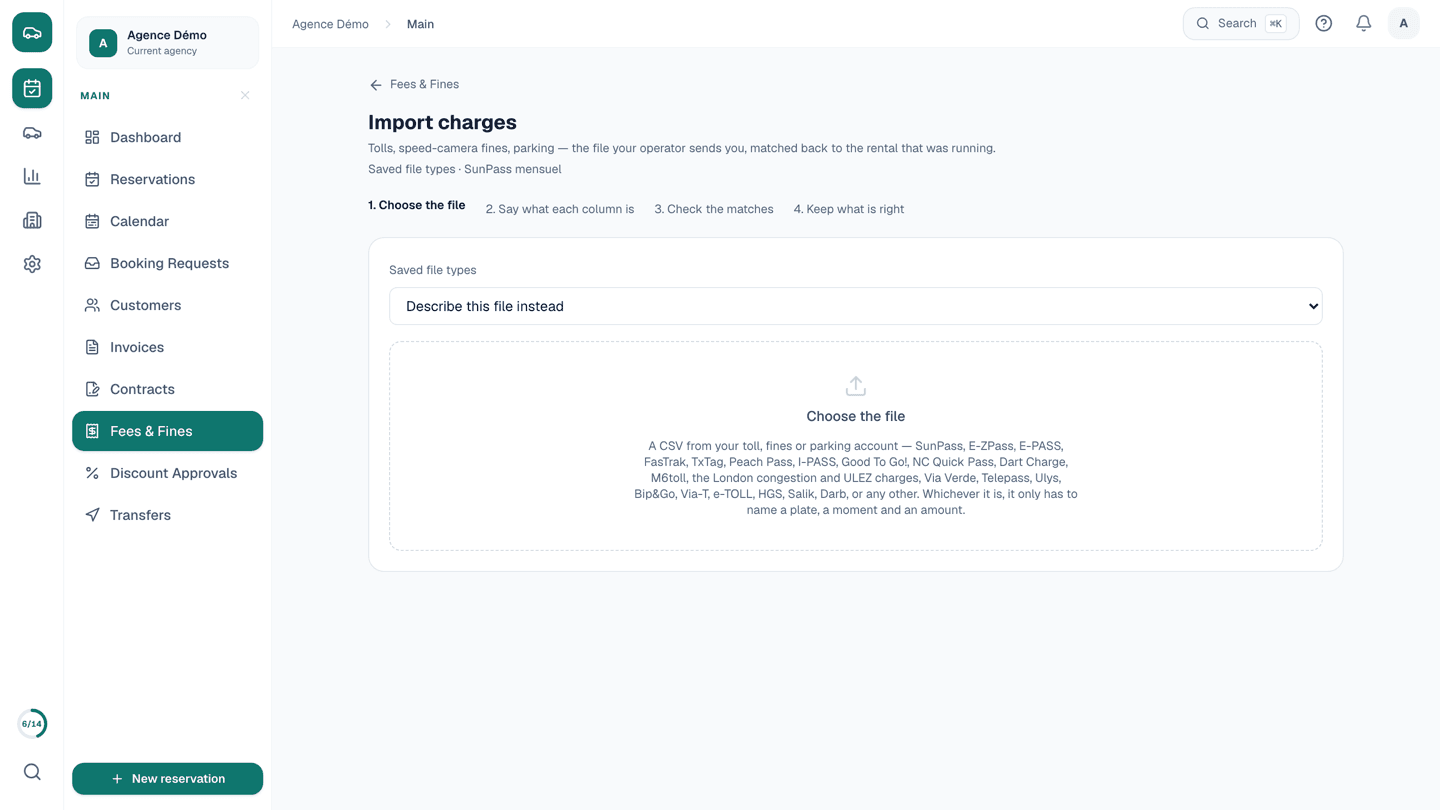
You describe your operator's file once: which column holds the plate, which one the timestamp, which one the amount, and what time zone it is written in. That description is saved. On the next statement all that is left is to drop the file and pick a name from a list.
Each line is then attached to the rental that was running, with the four traps handled. Timestamps are read in the operator's zone. Lines just outside a rental are flagged with the gap rather than assumed. Plates are compared without their punctuation. A passage already imported is skipped instead of being billed a second time. Your admin fee is added per line, and everything arrives waiting for your approval.
The mechanism is the same for a Florida toll account, a European motorway invoice or a stack of parking notices. The file format is something you describe, not something we have to support.
A fine is not a toll
They arrive the same way and they are handled completely differently, and treating them alike is how an agency ends up paying for someone else's speeding.
A toll is a debt. You owe it, you pass it on, the renter pays. A fine is a penalty attached to a person, and in most countries you have a legal duty to say who was driving rather than simply pay it and rebill.
Three practical consequences.
There is a deadline, and it is short. The window to name the driver is often measured in days, not weeks, and it starts when the notice is issued rather than when you open your post. A notice that sits in a drawer for three weeks has usually become yours.
You need the details the form asks for, not the ones you have. Full name, date of birth, licence number, address. If you only recorded a name and a phone number at the counter, you cannot complete the designation, and the fine stays with the company.
Failing to designate is usually its own offence. In several countries the penalty for not naming the driver is larger than the original fine, and it falls on the business rather than the person.
So keep fines in a different queue from tolls, sorted by deadline rather than by amount. A four-euro toll can wait a month. A speeding notice cannot wait a fortnight.
What an operator's file actually looks like
Before you automate anything, open the file. Four things vary between operators and all four quietly produce wrong results.
The date order. 08/09/2026 is the eighth of September in Paris and the ninth of August in Orlando. Read the wrong way round, most of the file becomes unreadable rather than wrong, which at least is visible. Read plausibly the wrong way, it is wrong and invisible.
The time zone. Almost every statement is stamped in the operator's local time. Your bookings are stored in UTC. Five hours of difference moves every charge near a handover onto the wrong rental.
The decimal separator. A file written with a comma, read as though it used a point, turns three euros fifty into three hundred and fifty.
What counts as the same charge. Some operators give every passage a reference. Where there is one, use it, because statement periods overlap and the same passage will arrive twice. Where there is none, the only reliable key is plate plus exact instant plus amount.
Get those four right once, save them as the description of that supplier's file, and every future statement from them reads correctly without anybody thinking about it again.
Read next
The named figures, vendor by vendor, are in six platforms and what they actually charge.
Questions people ask
Can I charge a toll to the customer after the rental has ended?
Yes, if your rental agreement says so before the customer signs. The clause needs to name what you will charge back, whether you add an administrative fee, and how long after the return you may still do it. Without it you are asking somebody to pay for something they never agreed to.
How do I know which renter was driving when a toll was charged?
By the timestamp, matched against the rental that was running on that vehicle at that moment. Two things break this quietly: the statement is in the operator's local time while your bookings are stored in UTC, and a toll five minutes after the return still belongs to the renter driving back.
What administrative fee can I add to a toll or fine?
Whatever your agreement states and local law allows, and it has to be proportionate to the work of processing it. The figure matters less than the fact that it was written down before the rental, not invented when the statement arrived.
How do I avoid charging the same toll twice?
Statement periods overlap, so the same passage arrives in two files. Match on the operator's own reference where the file has one, and on plate plus exact timestamp plus amount where it does not. Doing this by eye across three hundred rows is where the double charges come from.